The Cat and the Warship
by Laurie Corbett
“Vessel at approximate co-ordinates longitude 74 degrees 30 minutes, latitude 32 degrees 30 minutes, this is Canadian Sailing Vessel ‘Cat Tales’.”
These
are the words repeated over and over that slowly roused me from my sleep.
They seemed far away, unlike the rushing water and endless boat noise.
I jumped from the bunk, took a couple of steps to the stairway and
stepped up into the salon of the catamaran.
John Fallon, our navigator and Ham Radio operator, was repeating those
words into our VHF.
Doug Chown and Grant Sinclair, my
other shipmates, excitedly pointed off the port side to a light whose bearing
hadn’t changed for some time. We
were on a collision course.
John, Doug and Grant were aboard
the Tobago 35 Catamaran, helping me bring my freshly purchased boat home from
Martinique. We had already had lots
of excitement crossing the Caribbean Sea and were now heading diagonally to Cape
Hattaras from the Virgin Islands looking for a weather window we dare to use to
head more northerly.
The light to port had appeared
during Doug’s watch. He had
turned to radar on and had determined 8 miles out that this was a large vessel.
Doug had awakened Grant and John, who had more experience in the open
ocean, and told them what was up. John
had determined the unknown vessel’s approximate co-ordinates by using his GPS
and the digital charts he brought along with his new laptop.
Although his efforts to hail the ship woke me before he got an answer
from them, he was successful 5 minutes later when a young lady’s voice
responded. “This is United States
Warship #64. How may we help
you?”
John explained coolly and calmly
that we were a Canadian Sailing Vessel off to their starboard, that we were on a
collision course, and asked them how they would like to resolve the situation.
Experienced sailors know that without a coordinated effort to avoid a
collision, 2 vessels can make corrections independently and still collide, like
in a strange and dangerous game of “chicken”.
We waited anxiously for the
woman’s voice to come back to us with some kind of an answer; our anxiety
heightened not only by the growing size and nearness of the shadow on our radar,
but with the new knowledge that it was a honking big warship.
None too soon a male voice repeated the whole exchange from the beginning. “Vessel calling United States Warship # 64, what can we do for you?” Once again, John described the situation and asked for guidance. Once again the radio went dead as we waited anxiously a few more minutes before we heard any response. Finally it came. “Canadian Sailing Vessel Cat Tales, we will be crossing by your stern momentarily”. We sighed, and watched the much brighter light cross by our stern and head north.
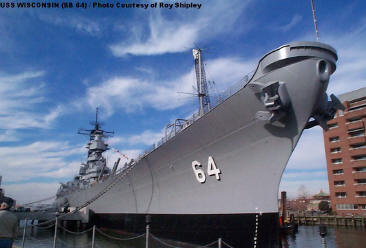
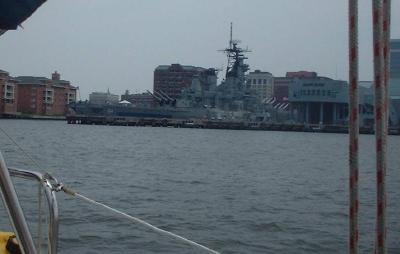
Approximately a week later, John and I motored the boat through the middle of Norfolk and into the Chesapeake. We had landed in Beaufort, below Cape Hattaras, looking for needed rigging and escape from forecasted bad weather. Grant and Doug had both run out of time and jumped ship, leaving John and me to ferry the boat up through the Intercoastal and on towards Canada. Although Norfolk was full of massive gray ships, we found Warship #64 sticking out from a slip behind the Navy Museum. A very impressive ship, and we were glad to get to see it in daylight, rather than the dark, up-close opportunity we almost had at sea. How it dwarfed the buildings around it, and what it would have done to our miniscule shell of fiberglass, monopolized our conversation until we were out the Chesapeake and well into the Atlantic.
 Home
Home